

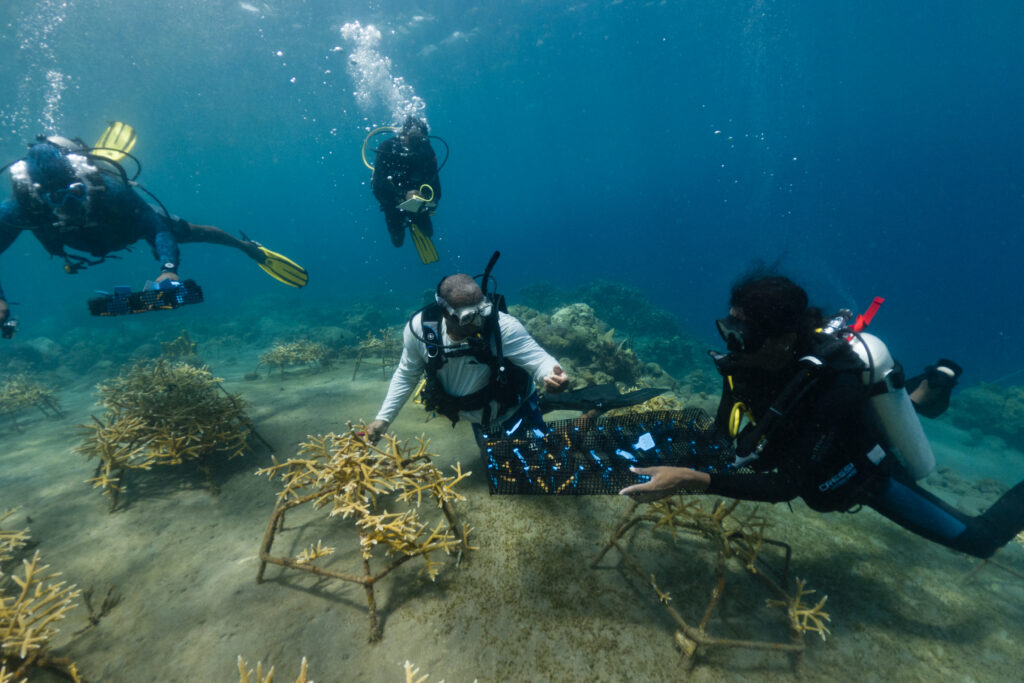
In a first for the region, a team of divers from CLEAR Caribbean and the Richmond Vale Academy, accompanied by a fisheries officer from Saint Vincent and the Grenadines, successfully transported 120 live coral fragments from Saint Lucia to Saint Vincent and the Grenadines on 22 July. The mission marks the first time governments have authorised the cross-border movement of corals to help save some of the Caribbean’s most endangered species.

The shipment of 60 elkhorn (Acropora palmata) and 60 staghorn (Acropora cervicornis) fragments was collected from CLEAR’s coral nurseries in Soufrière, Saint Lucia, and carried by boat in large coolers to a nursery off Chateaubelair, St. Vincent, and another nursery off Mayreau in the Tobago Cays Marine Park. This week the governments of both nations granted CLEAR Caribbean a historic permit to make the transfer — precisely to widen genetic diversity and give coral restoration a real chance of success.
The stakes could hardly be higher. The back-to-back marine heatwaves of 2023 and 2024 were the worst the region’s reefs have ever endured, bleaching and killing corals on a scale scientists once thought unthinkable. Staghorn and elkhorn — the two species that built the Caribbean’s shallow reefs for millennia — were hit hardest, and very few survive today. Their loss threatens the future of Caribbean fisheries, beaches and marine tourism.
Scientists say the way forward is clear. In a landmark paper published in Science last year, a group of the world’s leading coral researchers argued for scaling up restoration through “assisted gene flow” — the careful, managed movement of resilient corals or their gametes between populations so that heat-tolerant genes can reach the reefs that need them. Also known as genetic rescue, the approach has already helped many species adapt to a rapidly warming world.
“Sharing corals through regional nurseries is one of the most powerful tools we have,” said Falco Martin for CLEAR Caribbean. “Yet our laws, written for a more stable age, still treat any movement of corals with suspicion rather than urgency. The permit for this transfer shows what becomes possible when governments follow the science and choose rescue over risk.”

CLEAR’s coral restoration project is one of many Ecosystem-based Adaptation interventions funded by the Caribbean Biodiversity Fund (CBF) and supported by the German Federal Ministry for the Environment, Climate Action, Nature Conservation and Nuclear Safety through the International Climate Initiative and KfW. The CBF and its partners are encouraging governments to follow the science and allow regional sharing of resilient corals rather than restricting all movement.

Political leadership is now needed to help CARICOM develop clear, shared protocols for the safe movement of corals — with proper safeguards against disease — so that resilient stock can flow to where it is needed most. The science is settled on the direction of travel; what remains is the regional will. It is time for the Caribbean to shift from a mindset of risk to one of rescue, before the reefs that feed and protect us are gone.